ISF-10 is U.S. Customs and Border Protection’s ten-field pre-arrival data filing for ocean import shipments. It is filed before the cargo is laden aboard the vessel, it draws its data from the booking confirmation, commercial invoice, and packing list, and for a freight forwarder the hard part is not the rule. The hard part is that the data lives in email, spread across 3 or 4 documents from different senders, and has to be assembled by hand under a deadline of 24 hours before lading, with no second pass on the other side of a miss. This guide covers what ISF-10 is, what each field means, how the deadline works, and where the real operational difficulty actually sits.
The mechanics of ISF are well documented and most forwarders already know them. What is less examined is why a routine ten-field filing consumes so much operator time, which is a data-organization problem, not a knowledge problem.
What is an ISF?
ISF stands for Importer Security Filing. It is a pre-arrival data submission required by CBP under the Trade Act of 2002 and the SAFE Port Act of 2006, with the requirement effective from 2010. The intent is that CBP receives advance information about ocean shipments before the cargo arrives so it can assess risk before the vessel docks.
There are two forms. ISF-10 covers most ocean import shipments. ISF-5 covers in-bond shipments, freight remaining on board, and a few other scenarios. ISF-10 is the one most forwarders file day to day, so it is the focus here.
ISF is a data filing, not a clearance. It does not replace the entry. It is an early, structured description of the shipment and its parties, submitted on a clock that runs off the vessel’s departure.
What are the 10 ISF fields?
ISF-10 requires exactly ten data elements from the importer’s side. They split into two groups by when CBP needs them.
Required no later than 24 hours before the cargo is laden aboard the vessel at the foreign port:
- Seller: the entity selling the goods to the buyer, often a manufacturer or a trading company.
- Buyer: the entity buying the goods, usually the U.S. importer of record.
- Importer of Record number: the IRS number, EIN, or CBP-assigned number of the party responsible for the merchandise once it enters the U.S. Often the buyer, not always.
- Consignee number: the IRS number, EIN, or CBP-assigned number of the party the cargo is consigned to in the U.S., often the importer.
- Manufacturer or Supplier: who made the goods. Not always the seller; a trading company often sells without manufacturing.
- Ship To Party: the first U.S. delivery destination after clearance.
- Country of Origin: where the goods were made, not where they shipped from.
- Commodity HTS-6: the Harmonized Tariff Schedule number at the 6-digit level.
Filable as late as 24 hours before arrival at the U.S. port (the two flexible fields):
- Container stuffing location: the name and address of the place where the container was loaded.
- Consolidator (stuffer): the name and address of the party that stuffed the container or arranged for it to be stuffed.
The carrier’s SCAC is not one of the ten. The vessel operator supplies its own two elements separately, the vessel stow plan and container status messages, which is where the “+2” in 10+2 comes from.
When does ISF-5 apply instead of ISF-10?
ISF-5 is the shorter filing for shipments that are not standard ocean imports for U.S. consumption: freight remaining on board, immediate exportation, transportation and exportation, and goods moving in-bond. It requires five elements rather than ten, reflecting that the party filing usually has less of the commercial detail.
Most forwarders file ISF-10 daily and ISF-5 rarely, but it is worth knowing the distinction so a job that should be ISF-5 is not forced through the ISF-10 process and chased for fields that do not apply. The decision of which form applies is a classification of the shipment type, made once at intake, and it is exactly the kind of determination that should be set deliberately rather than assumed from habit.
When is the ISF-10 deadline?
The ISF must be on file with CBP 24 hours before the vessel departs the last foreign port. Departure, not arrival. For a vessel departing on a Tuesday morning local time, the ISF has to be in well before that, which in U.S. terms is often the prior weekend.
Short-voyage shipments from Canada and Mexico use a 24-hours-before-arrival rule instead. Trans-Pacific and trans-Atlantic sailings use the departure-based rule. The governing reference is CBP’s ISF rule at 19 CFR Part 149, which is the source to cite for the timing, not a blog.
The operational point is the one that matters. The clock is set by a document that arrives in an inbox. If the booking confirmation lands on a Monday and nobody opens it until Tuesday, the window has already moved. The deadline is not the difficulty. Seeing the email in time, and turning it into a filing, is.
Where does ISF data come from?
Every ISF field is copied from a document the forwarder did not create. The seller, buyer, and value come from the commercial invoice. The manufacturer and country of origin come from the invoice and sometimes a separate declaration. The vessel and container come from the booking confirmation and the bill of lading. The HTS-6 is a classification judgment made against the commodity description.
None of these arrive in a structured form. They arrive as PDFs and email text from agents and factories, in inconsistent formats, on no schedule. The ISF is not hard because the rule is complex. It is hard because assembling ten clean fields out of that inbound stream, by hand, for every shipment, is slow and easy to get wrong.
Why is ISF data so hard to assemble?
| Field source | Where it lives today | The problem | Where it should be |
|---|---|---|---|
| Commercial invoice | PDF in an email thread | Re-keyed by hand per job | Parsed into the job record |
| Booking confirmation | Separate email | Read separately, re-typed | Bound to the same job |
| Manufacturer / origin | Invoice or follow-up email | Often ambiguous, guessed under time pressure | Flagged for a deliberate decision |
| HTS-6 | Classification judgment | Made fast while buried in transcription | Surfaced with source text for review |
| Vessel / container | Booking / B/L | Entered twice, inbox then TMS | Entered once, reviewed once |
The pattern is the same across the whole filing. The data exists. It is just scattered across email and re-typed into the TMS by a person, which is the actual cost.
How accurate does an ISF filing need to be?
CBP expects the ISF to be accurate, not just on time. The fields most prone to error are HTS, country of origin, and manufacturer, precisely because they come from foreign documents that do not always describe the commodity consistently and because a trading company is not always the manufacturer.
This is a review problem, not a typing problem. The person filing needs to see each field next to where it came from and make a deliberate call on the ambiguous ones. When that judgment is bundled with an hour of transcription, it gets rushed. Separating the two, fast mechanical data assembly and slow deliberate review, is what makes an ISF both quick and correct.
What are the most common ISF filing errors?
The fields that cause trouble are predictable, and every one of them is a data and judgment problem, not a knowledge gap.
The manufacturer versus seller split is the most frequent. A trading company sells the goods but does not make them, and the invoice often names only the seller. Getting the manufacturer right means reading the documents carefully or sending a follow-up, which is slow when it is done by hand under a clock.
Country of origin gets confused with country of export. The goods can ship from one country and be made in another. The ISF wants where they were made, and the shipping documents lead with where they left from, so the wrong value is easy to carry forward if nobody is checking the source.
HTS at the 6-digit level is a classification call against the commodity description, and foreign descriptions are not always precise. Invoice and packing list disagreements on quantity or weight are common and have to be reconciled before the filing, not after.
None of these are exotic. They are the same handful of judgments on every job. The reason they produce errors is not that forwarders do not understand them. It is that they are made quickly while the person is also transcribing everything else, which is the case for separating fast data assembly from deliberate review.
What does an assisted ISF workflow look like?
When the data assembly is automated and the review is kept, the ISF workflow looks like this:
- The booking confirmation and pre-alert arrive in the inbox and are bound to the correct job automatically.
- The seller, buyer, manufacturer, origin, HTS candidate, and vessel fields are extracted from the documents with a confidence score and the source text for each.
- Low-confidence fields, typically manufacturer and HTS, are flagged for a deliberate decision instead of being buried.
- The filer reviews the pre-filled fields against their sources, corrects what needs correcting, and approves.
- The approved data moves to the filing path and the TMS. Nothing is submitted without that human approval.
The clock starts when the email arrives, not when someone gets to the inbox, which is the difference between a comfortable filing and a rushed one.
Who is the filer of record?
The ISF filer of record is the party whose ISF filer code is on the submission. For most small U.S.-based forwarders who do not hold a customs broker license, that is the licensed third-party broker they outsource to, and that broker carries the regulatory responsibility.
This does not change with automation. The filer of record still reviews and submits. Software can assemble and pre-fill the data and enforce that a human approves it, but the licensing and the responsibility sit exactly where they did before. The filer-in-loop rule is not optional and is not bypassed.
How does TIO help with ISF filing?
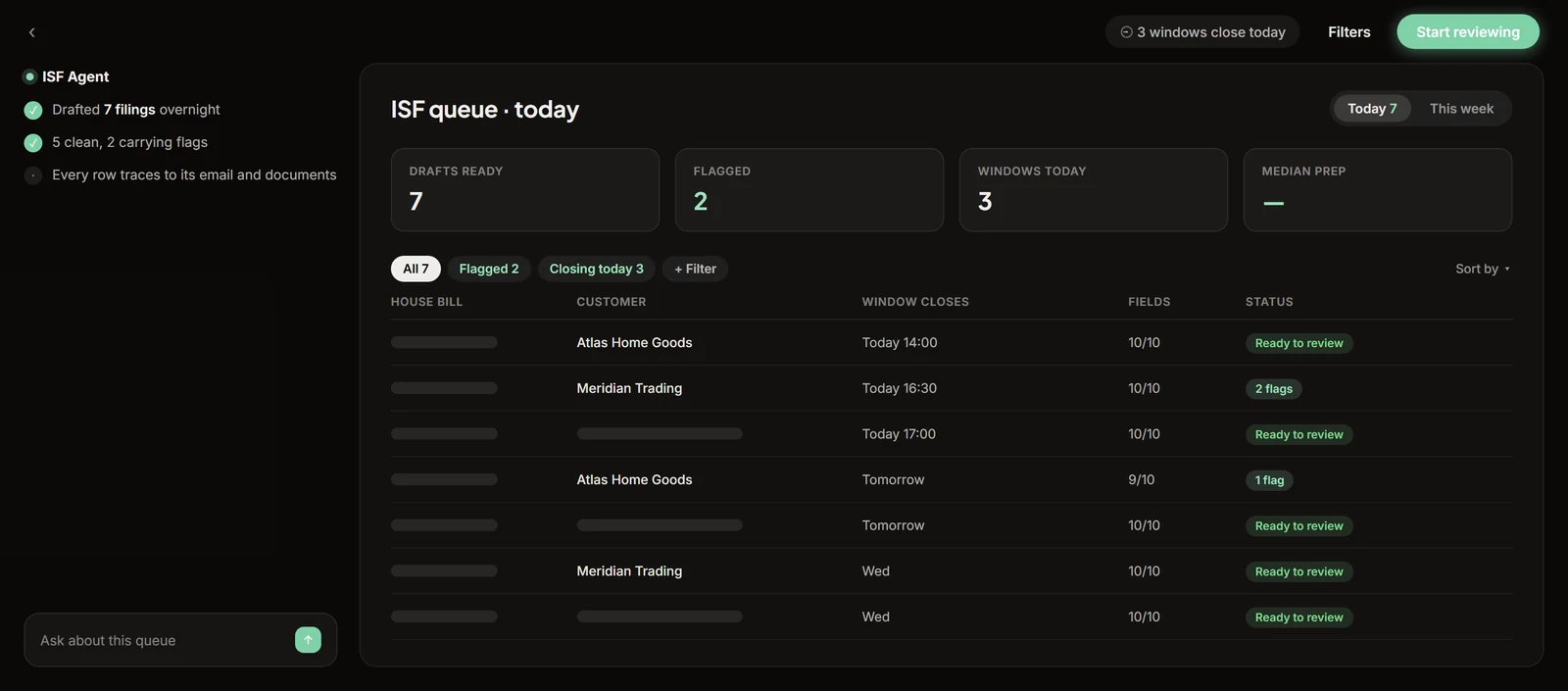
TIO connects to the inbox, reads the booking confirmation, commercial invoice, and packing list as they arrive, binds them to the right job, and pre-fills the ISF fields with a confidence score and the source text for each one. Low-confidence fields, the manufacturer-versus-trading-company case being the classic one, are flagged rather than buried. The filer reviews the pre-filled fields, corrects what needs correcting, and submits. Nothing reaches the broker path or the TMS without that review.
The compliance step is not the thing being changed. The data assembly in front of it is. The filer keeps doing exactly what they did; they just stop transcribing to do it. This is the same email-to-record problem described across the rest of the freight forwarder workflow, and ISF is one instance of it.
Summary
ISF-10 is a ten-field CBP pre-arrival filing for ocean imports, due 24 hours before vessel departure under 19 CFR Part 149. The rule is not the hard part and forwarders already know it. The hard part is that every field is copied by hand out of scattered email into the TMS, which is slow, easy to get wrong on the ambiguous fields, and scales with shipment volume. The fix is not knowing more about ISF. It is organizing the data so the filing assembles itself and the filer reviews instead of types.
For the term itself and related definitions, see the ISF entry in the freight glossary. To see the data-assembly step run on a real shipment, a live demo walks it end to end in about twenty minutes.
Frequently asked questions
What is ISF-10 and who must file it?
ISF-10 is CBP's ten-field pre-arrival ocean import filing required under 19 CFR Part 149. It must be filed by the importer of record or a licensed customs broker acting as the filer of record before ocean cargo is laden aboard the vessel at the foreign port. A freight forwarder without a customs broker license cannot be the filer of record.
When is ISF-10 due and what happens if it is filed late?
ISF-10 is due no later than 24 hours before cargo is laden aboard the vessel. A late filing is a violation on the importer's record, and CBP can place a do-not-load order, which holds the shipment at origin. Most forwarders build a buffer into their process to avoid cutting it close on overseas agent communication.
What are the 10 required fields in an ISF-10 filing?
The ten mandatory fields are: seller, buyer, importer of record, consignee, manufacturer or supplier, ship-to party, country of origin, HTS number, container stuffing location, and consolidator. The first eight come from the commercial invoice and booking confirmation. The last two describe where the goods are physically consolidated.
Can a freight forwarder file ISF on behalf of an importer?
A freight forwarder can coordinate and assemble ISF data, but the actual submission must be made by a licensed customs broker who holds an ISF filer code registered with CBP. The broker is the filer of record and carries the regulatory liability. The filer reviews and approves every submission before it goes to CBP.