Your team should be doing freight, not data entry.
The back office is where a forwarder quietly loses hours: reading emails, keying worksheets, chasing documents, reconciling charges. TIO's agents do that work and hand your team a finished draft to approve.
The work that scales with volume, not value.
Booking confirmations, pre-alerts, bills of lading, invoices. Every one gets read by a person and typed into the TMS by hand. It works until volume climbs, and then it is the first thing that breaks: filings go out late, entries carry errors, the team works the weekend to catch up.
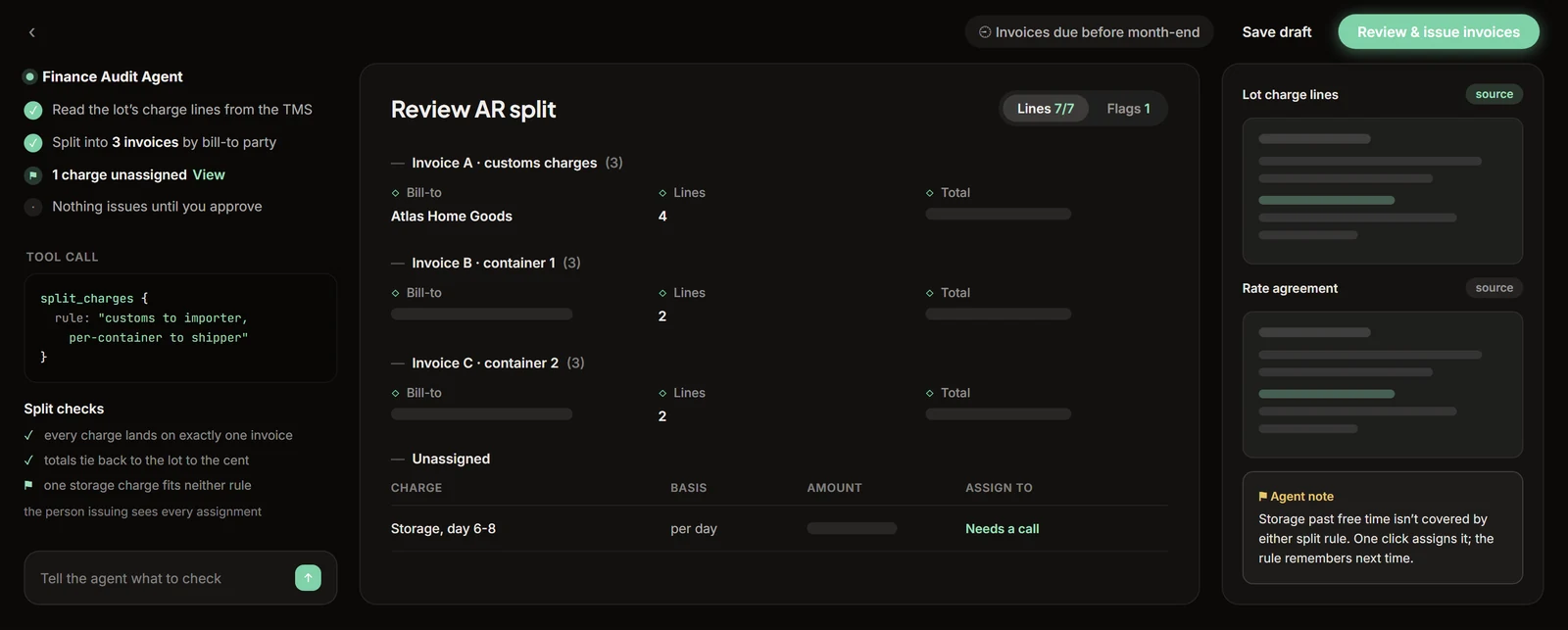
Less ramp-up. Faster deployment. No new system.
Day one
The agents start immediately and work the way your team already works. There is no months-long rollout and no software for the team to learn.
They learn your business
Every correction becomes a rule the agent keeps: your parties, your suppliers, your conventions. Month two is sharper than week one.
You stay in control
Run each agent with a person approving every record, or autonomous once you trust it. You choose per agent; customs filing always keeps a human filer.
Straight answers.
Which back-office jobs can the agents take over?
The ones that are reading and keying rather than judgment: drafting the ISF-10 from the worksheet, creating the lot in your TMS with charge lines, pricing inbound quote requests from your rates, and re-checking filed work. At the US import forwarder running the agents in production, lot creation went from about 30 minutes to seconds and ISF prep from about 15 minutes to seconds.
What stays with our team?
Every decision and every approval. The agents stop at a finished draft; a named person reviews it before anything files with customs or writes to the TMS. Carrier selection, customer commitments, and exception calls stay human. The agents remove the keying, which at the production forwarder was worth roughly 17.5 hours a week.
Do we have to rip out our TMS to automate the back office?
No. The agents sit between the inbox and the TMS you already run, and that TMS stays the system of record. There is no migration, no parallel system, and 0 new screens for the ops team; the reviewed record lands in the same place it always has.
How is this different from hiring another ops person?
An ops hire costs recruiting, months of ramp, and a salary that scales with headcount, and the keying still gets done one email at a time. An agent does the same prep in seconds at any volume; at the production forwarder that keying was worth roughly 17.5 hours a week. Pricing follows the same logic: per agent, a fraction of the hire it replaces, not per seat.
See it on your own shipments.
Twenty minutes, no setup. Bring a real document and watch an agent take it to a finished draft while you’re on the call.
Book a demo