An AI lot agent automates order entry by reading the shipment email and its documents, extracting the 20-odd fields an ocean import lot needs, and staging a complete TMS record, charge lines included, for a person to review and accept. At the US import forwarder running the agent in production, lot creation went from about 30 minutes of reading and keying per shipment to seconds of agent work plus a short human review, across 25+ jobs a week. The fields come from 4 different documents, the bill of lading, the house bill, the commercial invoice, and the pre-alert, and the agent reads them the way an operator does, by meaning rather than position. Nothing writes to the TMS until a person approves it; the agent does the transcription and the team keeps every call.
Nobody grows up wanting to do order entry. It is the work that fills the gaps between the real work: a booking lands, and before anyone can do anything useful with it, a shipment record has to exist in the TMS. Parties, ports, vessel and voyage, containers, commodity, charges. Twenty-odd fields for an ocean import, pulled from four different documents, typed in by hand, on every single job (the lot is the TMS job record that holds them). It is the most repeated task in the back office and the one that requires the least thought, which is a strange combination, and exactly the combination a machine is good at.
An AI lot agent reads those four documents and builds the draft record in about a minute. Then it hands the draft to a person to check and accept. That is order entry automation, and of all the things people claim AI can do for freight, this is one of the few it actually does.
We already built an ISF agent for the 10+2 filing. The lot agent is the same idea pointed at a different job. This post is about that job, order entry, and about where the person stays firmly in charge.
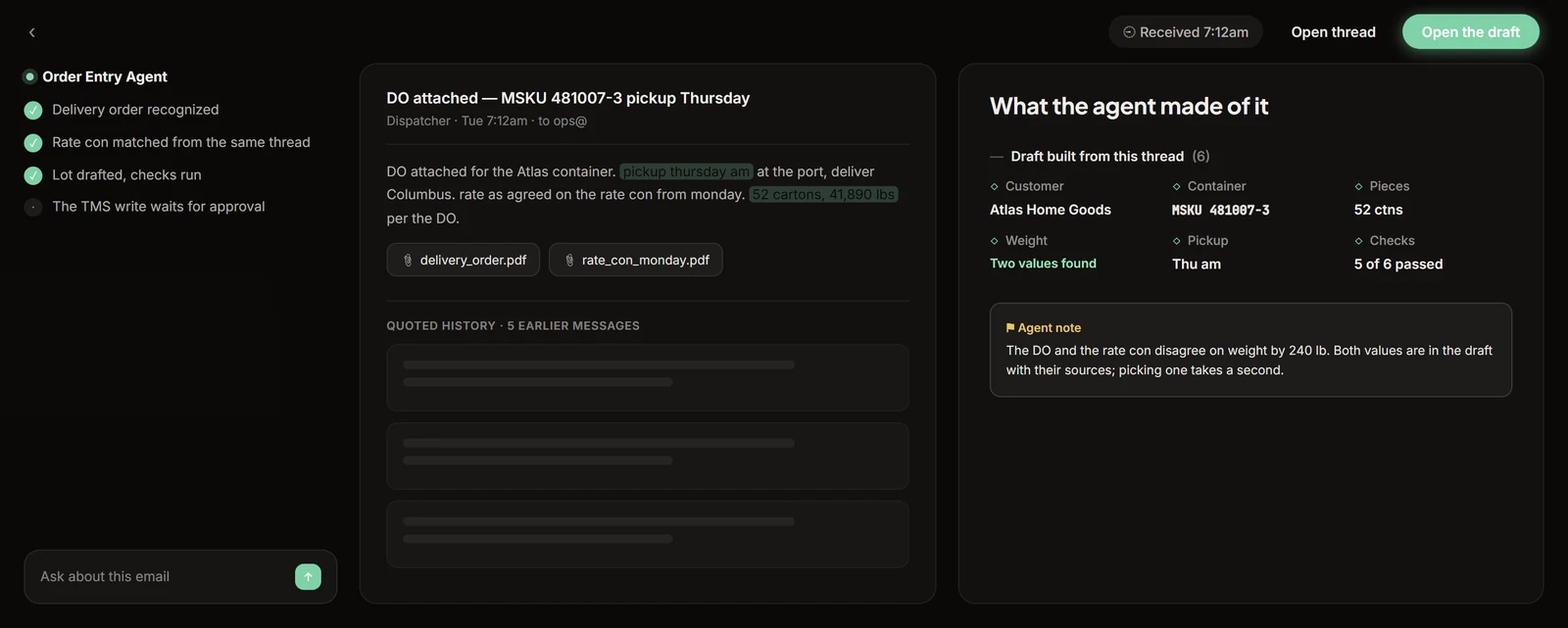
The problem is not the fields. It is that they are scattered.
A lot is just the shipment record, and the fields it needs are not a secret. Importer and consignee. Shipper and seller. Origin and destination. Vessel and voyage. Container numbers and sizes. Commodity and code. House and master bills. The charge lines. An ocean import runs about twenty of them. A domestic move is a different set, same idea.
But not one of them lives in the same place. The booking confirmation has the vessel and voyage. The origin agent’s worksheet has the parties and the stuffing location. The bill of lading has the containers and the bill numbers. The packing list and the invoice carry the commodity and the values. So a person opens all of them, hunts down each field, and keys it in. Call it fifteen to thirty minutes a lot, every lot.
What makes it costly is not the difficulty. It is the repetition, the clock, and the fact that a consignee whose name is spelled three ways across three documents, or a container number off by one digit on a Friday afternoon, turns into someone else’s problem next week. This is boring work that punishes a lapse in attention, which is the worst kind.
What the lot agent does with the pile
Think of it as the colleague who can read four documents at once and never gets bored halfway through the invoice.
Someone forwards the shipment email to the agent. It reads the body and every attachment, the worksheet, the bill of lading, the packing list, the invoice, and pulls the fields for the lot. It matches the parties against records you have built before, so the consignee spelled three ways collapses to the one you actually use. It assembles the whole draft and emails it back for review.
On a normal shipment that read-and-build pass takes about a minute. A lean one with two documents can land in twenty seconds. A heavy one, ten attachments deep with origin and compliance certificates, takes longer, because the reading is the work and there is simply more of it. Set any of those against fifteen to thirty minutes of manual keying and the pass is effectively free, and it happens before anyone has opened the file.
It reads with a vision-capable model, so the format does not matter. An Excel worksheet, a scanned PDF of a bill of lading, an invoice with the numbers buried in an attached sheet, all read the same way. It works off labels, not positions, so one origin agent’s worksheet and another’s both resolve without anyone building a template for each layout.
Side by side, the two ways of building a lot look like this.
| Building a lot by hand | Building a lot with the agent |
|---|---|
| Open four documents and hunt down each field | Reads the email and every attachment in one pass |
| Key twenty-odd fields into the TMS | Assembles the draft and emails it back for review |
| Fifteen to thirty minutes per lot | About a minute, then a quick human review |
| Retype consignee names and container numbers | Resolves parties against lots you have built before |
| Learn each origin agent’s layout | Reads by label, any layout, ocean or domestic |
Why it works for a forwarder it has never seen
The agent is not wired to one company’s setup. Three things keep it portable.
It lives between the inbox and the TMS. It does not replace your TMS and it will not ask you to migrate onto anything. It reads your email and writes to your TMS through the API the platform already exposes, and that covers the systems most forwarders run on. Your stack does not change.
It learns your desk from your own history, not from a template. The party matching, the commodity patterns, the charge lines it expects, all of that comes from the lots you have already built. A consignee you handle every week pre-fills cleanly because the agent has seen how that consignee’s paperwork behaves. A first-timer gets flagged for a closer look. The longer it runs on your book, the sharper it gets on your book specifically.
It does not care about the lane. Ocean import and domestic trucking are different records with different fields, and the agent handles both from the same inbox. It reads the lane off the documents instead of asking you to pick one.
Two agents, one honest pattern
The lot agent and the ISF agent are the same move applied twice. Read the email and the documents. Pull the fields and check them. Flag whatever is uncertain. Hand a person a finished draft. Neither one files or creates anything by itself. Both take away the assembly, which is where the hours go, and leave the judgment, which is where they belong.
That is the version of AI a forwarder can actually put to work this quarter. Not a system that runs the business. A handful of narrow agents, each one taking a single high-volume, low-judgment job off the desk. Order entry is the highest-volume of the lot, which is why it is the first one worth handing over.
The same job, at a 3PL or a logistics desk
None of this is unique to forwarders. A 3PL spinning up shipment records from customer emails, a logistics team keying orders off inbound paperwork, a broker building entries from origin docs: it is all the same shape. Structured data, scattered across attachments, assembled into a record by hand. Wherever an order or shipment record gets built from an inbound email, the lot agent fits. The documents change and the destination system changes. The read, resolve, and stage flow does not.
A person accepts every lot
To be clear about the part that matters: the human does not leave order entry. The agent builds the draft and stages it. It flags the handful of fields it is unsure about, so the reviewer looks where it counts instead of eyeballing all twenty. The reviewer checks those, fixes anything wrong, and accepts the lot into the TMS. The agent never creates the record on its own. It offers a draft, and a person says yes.
That split should make sense to anyone who has done the work. The machine does the reading and the typing. The person still makes the calls that carry weight. What goes away is the twenty minutes of assembly. What stays is the two minutes of judgment, which was the point all along.
Putting one on your desk
There is no project to stand up. The agent connects to your inbox and your TMS, learns from a batch of your recent lots, and starts handing you drafts to review. You keep your current process running next to it until the drafts on your regular consignees stop needing corrections, and then you stop double-entering.
If order entry is quietly eating your team’s week, book a short demo and bring a few of your own shipment emails. We will run them live and show you the draft lot it stages for review, on your documents, in about a minute.
Frequently asked questions
What is order entry automation for freight forwarders?
Order entry is the work of creating a shipment record, often called a lot or a job, in the TMS: the parties, the ports, the vessel and voyage, the containers, the commodity, and the charges. Automating it means an AI agent reads the inbound shipment email and its attachments, extracts those fields, resolves the parties against records you have filed before, and prepares the lot for a person to review and accept. The agent does the assembly. A team member confirms the flagged fields and accepts the lot. Nothing is created in the TMS without a person.
What AI agents can a freight forwarder use today?
The useful ones are task-specific and email-native. An ISF agent reads the origin worksheet and house bill and prepares the 10+2 filing for a person to review and submit. A lot agent, or order-entry agent, reads the booking and pre-alert documents and prepares the TMS lot for a person to accept. Both follow the same pattern: the agent reads the email and documents, extracts and validates the fields, flags what is uncertain, and hands a person a complete draft. The person makes every call that carries liability. This is where AI is genuinely useful in freight right now: the high-volume, low-judgment data assembly, not the judgment itself.
Does an AI lot agent create the TMS record automatically?
No. A responsible lot agent prepares the record and stages it for review. It reads the documents, populates the fields, flags the ones it is not sure about, and emails a complete draft to the team. A person reviews each flagged field, corrects what needs correcting, and accepts the lot into the TMS. In practice the agent flags several fields per shipment for human confirmation. The point is not to remove the person. It is to remove the twenty minutes of keying that happens before the person's judgment is even needed.
Does order entry automation work with my TMS, and does it work for a 3PL?
It works with any TMS that has an API, which covers the major platforms freight forwarders and 3PLs run on. The agent sits between the inbox and the TMS, so there is no migration and no rip-and-replace. The same order-entry burden exists for 3PLs and logistics teams that create shipment or order records from inbound email, and the same agent applies. What it learns is your operation: the consignees you handle, the party names that vary across documents, the codes you file for a given commodity. That learning comes from your own filing history, not a generic template.