A pre-alert is the document package an origin agent sends ahead of a shipment so the destination team can clear customs and plan delivery. For an ocean import forwarder it is the trigger for almost all back-office work on the job, and the workflow that follows it is where small teams lose the most operator time. A complete package carries 4 core documents, the house bill, master bill, commercial invoice, and packing list, and turning it into a lot in the ocean TMS costs an operator 20 to 30 minutes of reading and keying on a clean job. This guide walks that workflow end to end, names the document and owner at each step, and shows where the time and errors actually accumulate.
The short version is below as a step list, then each step is broken out with the input document, who owns it, what drives the deadline, and the failure that most often happens there. If you run ocean import, the value is in seeing the whole chain in one place, because the cost is not in any single step. It is in the handoffs between them.
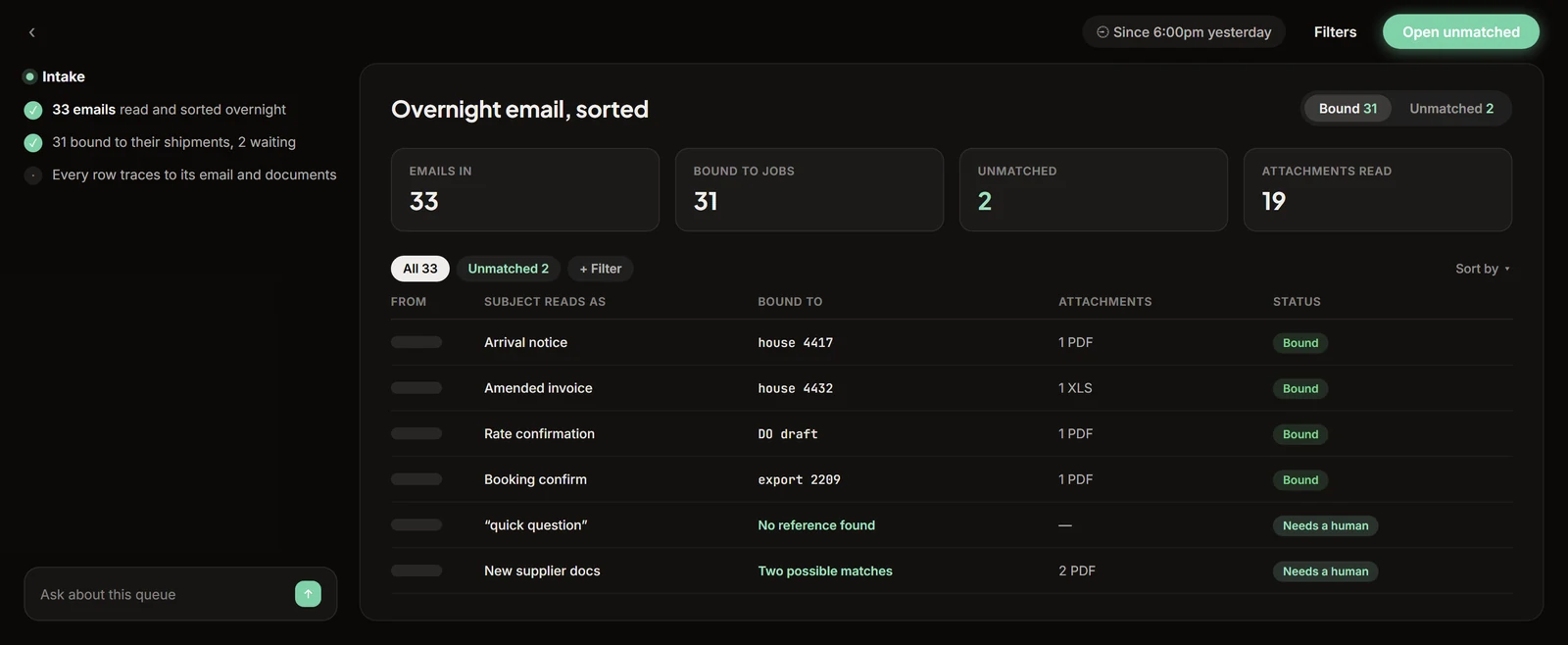
What is a pre-alert?
A pre-alert is the package an overseas agent or origin office sends before a shipment arrives. It typically carries the bill of lading, the commercial invoice, the packing list, and arrival details. It is not a single form. It is a bundle of documents from a party you do not control, arriving on no fixed schedule, that the destination team has to read, reconcile, and turn into structured records.
Everything downstream depends on the data inside the pre-alert being read correctly and entered on time. That is why the pre-alert is the right place to start when you are trying to find where a forwarder’s hours go.
What does a complete pre-alert contain?
A clean pre-alert lets the destination team move without a single follow-up email. It contains the full bill of lading with the master and house numbers, a commercial invoice with the seller, buyer, value, currency, and Incoterm, a packing list that agrees with the invoice on quantity and weight, the vessel and voyage with the ETD, the container and seal numbers, and an unambiguous statement of the manufacturer and country of origin.
The reason this matters is that every gap in the pre-alert becomes a reconcile-step failure later. A missing manufacturer turns into a follow-up email and a stalled ISF. An invoice that disagrees with the packing list turns into a judgment call under time pressure. A pre-alert that omits the Incoterm turns into a charge dispute at invoicing. The quality of the inbound document sets the ceiling on how fast the rest of the workflow can run, which is why the agents who send complete pre-alerts are the jobs that close in minutes and the ones who do not are the jobs that eat an afternoon.
You cannot fully control what an overseas agent sends. You can track which agents send incomplete pre-alerts and how much that costs you, which is a conversation worth having with the ones at the bottom of that list.
What does the ocean import workflow look like end to end?
Here is the full workflow for a typical ocean import job, from the agent pre-alert to an approved lot in the TMS.
- Pre-alert received from the origin agent, bound to the correct job.
- Documents read: bill of lading, commercial invoice, packing list.
- Fields reconciled across documents, shipper, consignee, manufacturer, HTS candidate, country of origin, value.
- ISF prepared from the reconciled data.
- Filer of record reviews the ISF and submits it to CBP.
- Lot created in the TMS with the job fields.
- Arrival notice received, charges and release instructions reviewed.
- Customs clearance and release confirmed.
- Drayage and delivery scheduled against free time.
- Charges reconciled, invoice issued, job closed.
Steps 2 through 6 are where the manual transcription concentrates. Steps 7 through 10 are where deadline reaction time matters most. The first cluster is a data-entry problem. The second is a “did anyone see that email” problem. Both are back-office problems, not TMS problems.
Which document and owner sit at each step?
This table is the workflow as a reference. It names the input document, the owner, what drives the deadline, and the failure that most commonly happens at that step.
| Step | Input document | Owner | Deadline driver | Common failure |
|---|---|---|---|---|
| Pre-alert intake | Agent pre-alert email | Ops | ETD | Email missed or bound to wrong job |
| Document read | B/L, invoice, packing list | Ops | ISF window | Misread field, wrong party |
| Reconcile | All of the above | Ops | ISF window | Invoice vs B/L mismatch unresolved |
| ISF prep | Reconciled data | Ops | 24h before lading | Late start, low-confidence HTS |
| ISF submit | Prepared ISF | Filer of record | 24h before lading | Submitted late or with an error |
| Lot creation | Job fields | Ops | Internal | Re-typing errors into the TMS |
| Arrival notice | Carrier notice | Ops | Free time | Notice not actioned in time |
| Clearance | Broker confirmation | Broker / Ops | Free time | Release not tracked |
| Drayage | Dispatch | Ops | Free time | Container sits, demurrage accrues |
| Invoice | Charge documents | Accounting | Internal | Charges not reconciled to the job |
Where do the deadlines come from?
Two clocks drive an ocean import job. The first is the ISF window. Under CBP’s rule at 19 CFR Part 149, the Importer Security Filing must be filed no later than 24 hours before the cargo is laden aboard the vessel at the foreign port. That clock starts at the ETD on the booking, not at arrival, which is why a late-arriving or misread pre-alert is a compliance risk and not just an inconvenience.
The second clock is free time at destination. Once the container is available, demurrage and detention begin accruing if it is not picked up within the allotted window. That clock is driven by the arrival notice and customs release, and it is unforgiving. A slow reaction to an arrival email is a direct cost.
Neither clock is set by your TMS. Both are set by documents that arrive in an inbox. The TMS records the result. It does not watch the clock for you.
Where do time and errors accumulate?
The expensive part of this workflow is not the judgment. It is the transcription around the judgment.
In the US forwarder case study, the email-to-TMS step took roughly 45 to 90 minutes per job by hand depending on document quality, and dropped to an 8 to 12 minute review once the data-entry step was automated. The realized result across nearly 200 shipments a month was close to 20 hours a week returned, per staff member. Source: TIO customer case study, 2026.
That time is not spread evenly. It piles up at the reconcile and lot-creation steps, and it spikes on messy jobs: a commercial invoice that disagrees with the B/L on quantity, a factory using a non-standard format, or a manufacturer that has to be confirmed by a follow-up email before the ISF can proceed. A team sized for the average job is underwater whenever a cluster of messy ones lands in the same week, which tends to be exactly during peak season.
Which step slips most?
Across the whole workflow, one step fails more than the others, and it is worth naming.
The reconcile step is where jobs go wrong. The single most common failure is a manufacturer-versus-trading-company ambiguity or an uncertain HTS classification that gets resolved by guessing under time pressure instead of by a deliberate decision. It is not a typing error. It is a judgment made too fast because the person was buried in transcription and the ISF clock was running. Fix the transcription load and the judgment gets the attention it actually needs.
This is the case for separating the two kinds of work. The transcription should be fast and mechanical. The classification and party decisions should be slow and deliberate. Bundling them into one rushed task is what produces the filing that gets penalized.
What does automating the data-entry step change?
Automating the workflow does not mean removing the review. It means removing the typing and keeping the judgment.
In practice: software reads the pre-alert on arrival, binds it to the right job, extracts the B/L, invoice, and packing list fields with a confidence score and the source text for each one, and pre-fills the ISF and the lot. The team reviews the pre-filled record, with low-confidence fields flagged rather than buried, corrects what needs correcting, and approves. The approved data writes to the TMS via API. The TMS stays the system of record.
The compliance posture does not change. The filer of record reviews and submits the ISF exactly as before. Nothing reaches CBP or the TMS without a person approving it. Every state change is logged immutably. What changes is that the reconcile and lot-creation steps stop being an hour of transcription and become a few minutes of review, which is also when the manufacturer and HTS decisions finally get the attention they always needed.
TIO runs this in production for forwarders today, across ocean import and every other lane. It is not a TMS and does not replace one. It removes the manual email-to-TMS step that this entire workflow is built around.
How does the workflow differ by lane?
Ocean import is the clearest version of this workflow, but the same chain runs in every lane with different documents and different clocks. Ocean export inverts the document flow: the booking and shipping instructions originate with you, and the export filing and carrier deadlines replace the ISF window, but the read-reconcile-record step is identical. Air import compresses the timeline, with a master and house air waybill in place of the bill of lading and a much shorter window from arrival to required action, so the same transcription has to happen faster, not slower. Domestic trucking trades the pre-alert for rate confirmations, dispatch sheets, and delivery receipts, and adds the work of chasing quotes and delivery information before anything reaches the TMS.
The point is that the bottleneck is structural, not lane-specific. Every lane is a version of read an inbound document, reconcile it, and record it, and every lane scales with its own volume. A team that fixes the step for ocean import has fixed the pattern for all of them. The freight forwarder solution overview covers the multi-lane version of this.
How do you tighten your own workflow?
You do not need new software to start. Three changes help immediately, with or without automation.
First, make pre-alert intake a tracked step, not an inbox habit. Every pre-alert should be bound to a job the moment it arrives, so nothing sits unread.
Second, separate reconcile from lot creation in how you measure the work. They are different skills and different failure modes, and lumping them hides where the time goes.
Third, treat the arrival notice like the ISF: a deadline-bearing document that triggers an action, not a notification to read later.
Then, if the measured time in the reconcile and lot-creation steps is the bottleneck, which for most ocean import forwarders it is, that is the step worth automating, because it is the one that scales linearly with volume and never gets easier on its own.
Where do you start?
The ocean import solution overview walks this same workflow from the product side, and a live demo runs a real pre-alert through it end to end in about twenty minutes with no slides. Bring a messy one. That is the job that shows whether any of this actually holds up.
Frequently asked questions
What is a pre-alert in ocean import freight forwarding?
A pre-alert is the document package sent by the origin agent to the destination forwarder before a shipment arrives. It typically contains the master bill of lading, house bill of lading, commercial invoice, packing list, and other clearance documents. It is the trigger for customs entry prep, ISF reconciliation, and TMS lot creation.
How long does it take to manually process a pre-alert and create a TMS lot?
A clean, well-organized pre-alert with complete documents takes 20 to 30 minutes to process into a TMS lot. A messy pre-alert with document discrepancies, non-English attachments, or missing HTS candidates can take 45 to 90 minutes. The time compounds when multiple pre-alerts arrive the same day.
What fields does a freight forwarder extract from a pre-alert to build a house record?
The house record fields drawn from the pre-alert include shipper, consignee, notify party, MBL number, HBL number, vessel, voyage, ETD, ETA, port of loading, port of discharge, commodity, pieces, weight, volume, and HTS candidate. Each field requires locating the correct document, reading the value, and keying it accurately into the TMS.
How does AI automation handle the pre-alert to TMS lot workflow?
An AI coordination layer reads the pre-alert email and its attachments on arrival, extracts each required field with a confidence score and source text, binds the pre-alert to the correct open job, and pre-fills the house record in the TMS queue. The forwarder reviews the pre-filled fields, corrects flagged items, and approves. Nothing writes to the TMS without that human approval.