The steamship line sends an arrival notice when the cargo hits the destination port. That email contains the last free day, the container number, the bill of lading number, and the destination and handling charges the importer must pay before the terminal releases anything. Free time runs from 3 to 5 days depending on the carrier’s tariff; after that, demurrage starts accruing per container per day. A forwarder processing arrival notices by hand reads the email, matches it to the open job in the TMS, records the last free day and charges, notifies the consignee, confirms customs clearance status, and coordinates pickup. That sequence takes 15 to 25 minutes per shipment (illustrative, based on typical ocean import ops team feedback). On 40 to 60 shipments a month, that is 10 to 25 hours of ops time.
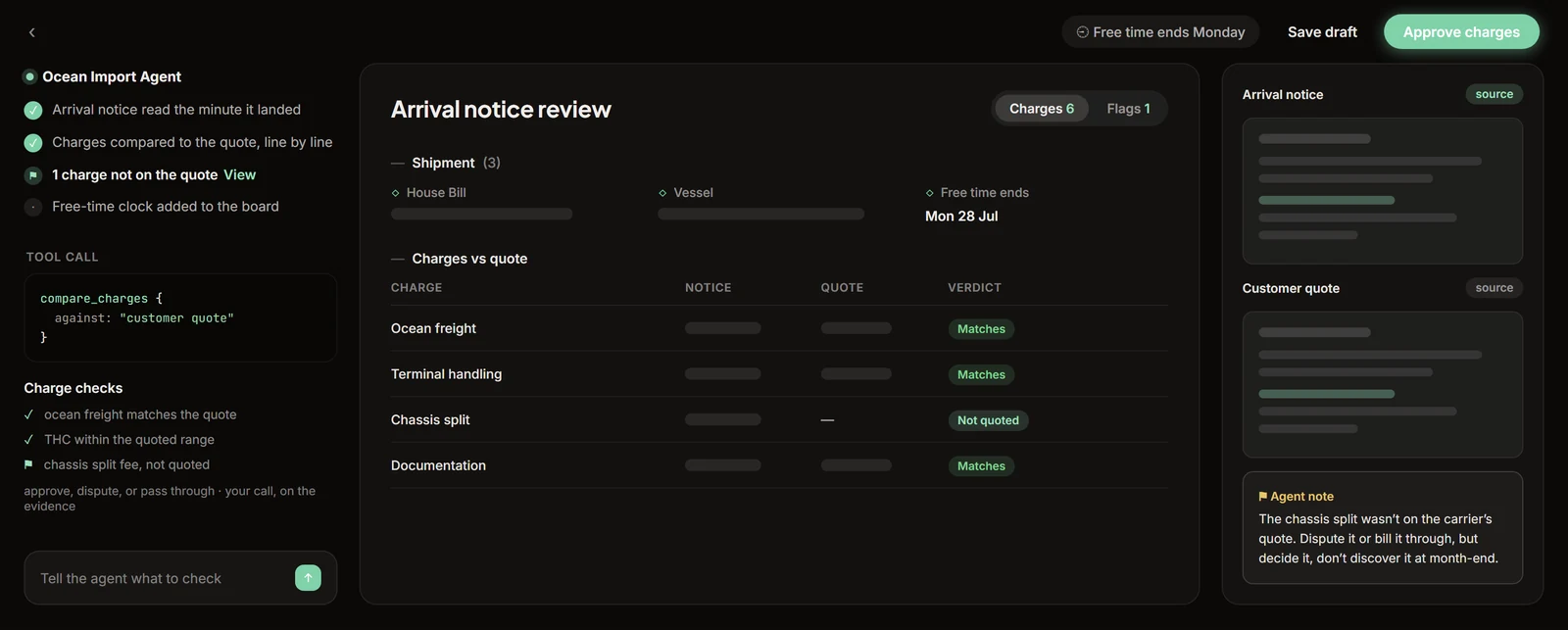
What does an arrival notice contain and what does the forwarder do with it?
An arrival notice contains everything the importer needs to pick up cargo: bill of lading number, container number, vessel name, voyage, estimated and actual arrival dates, last free day, and destination and handling (D&H) charges. The D&H charges are set by the steamship line at the port of discharge and must be paid before the terminal issues a delivery order authorizing release.
When an arrival notice lands in the ops inbox, the forwarder works through the same steps on every shipment. The bill of lading or container number has to match the right open job in the TMS: fast if the job was set up from the pre-alert, slower if it wasn’t. Once the job is found, the forwarder records the last free day and D&H charges in the TMS record and confirms the consignee has been notified with the key dates. Customs clearance has to be tracked in parallel. Both release and D&H payment have to clear before the terminal issues a delivery order.
All of it is reading data out of an email and moving it into the right place. Judgment only enters when something is wrong: a CBP exam hold, a D&H dispute, a consignee who can’t receive on schedule. That part comes after the data work.
| Manual arrival notice processing | With TIO |
|---|---|
| Read email, identify fields by hand | TIO reads and extracts fields on receipt |
| Search TMS for matching job by B/L | TIO binds to the open job automatically |
| Key last free day and charges into TMS | Extracted data presented for team review |
| Draft consignee notification manually | Key dates pre-populated in the notification |
| Check customs status in a separate system | Customs status surfaced alongside the notice |
| Coordinate pickup via separate workflow | All coordination from one review screen |
| 15 to 25 minutes per shipment (illustrative) | 2 to 4 minutes to review and confirm (illustrative) |
How does last free day work and who tracks it?
Last free day is the final date on which the importer can pick up cargo before the terminal begins charging demurrage. The forwarder is responsible for knowing it, recording it, and communicating it to the consignee before it arrives.
The calculation starts from the vessel’s actual date of discharge at the terminal, not the estimated arrival. The number of free days depends on the steamship line’s tariff for that port and trade lane. Most carriers publish their free time rules in their tariffs; the arrival notice usually states the last free day directly. When it doesn’t, the forwarder has to check the carrier tariff against the discharge date.
Forwarders sometimes treat last free day as a constant. It is not. A shipper who used one carrier on the last shipment may have had 5 days of free time. The current carrier on the same port may give 3. Using the wrong assumption costs the importer money, and nobody catches it until the demurrage invoice arrives.
The arrival notice is the source of truth for last free day on any given shipment. When the arrival notice is processed late, the last free day may already be imminent by the time the consignee is notified.
How does customs clearance affect cargo release timing?
Cargo cannot be released until CBP issues a customs release, and that review runs on its own clock, separate from the terminal’s free time. Both have to clear before the terminal issues a delivery order.
The forwarder’s job is to make sure the customs broker, whether in-house or a third party, has everything needed to file the formal entry: commercial invoice, packing list, bill of lading, and ISF filing confirmation. The ISF must have been filed at origin and accepted by CBP; problems with the ISF surface at entry and slow clearance. The forwarder also has to know whether the shipment is subject to a CBP examination, which adds to terminal time regardless of free days remaining.
A customs examination hold is one of the scenarios where the forwarder has to act before free time expires. Options vary by situation and by whether the consignee authorizes additional storage. But the decision starts with knowing the hold exists, which means checking customs status as part of arrival notice processing, not as a separate task scheduled for later.
Arrival notice processing and customs tracking have to run in parallel. A forwarder who finishes the arrival notice workflow and then checks customs status will sometimes find that free time has already been running on a shipment that won’t clear in time.
How does the arrival notice connect to what the overseas agent sent earlier?
The arrival notice is the destination-side counterpart to the pre-alert sent by the overseas agent. The pre-alert provided the outbound data before the vessel sailed: master bill, house bill, container number, vessel, voyage, ETD, and ETA. The arrival notice confirms what actually happened on the inbound side and triggers the charges and deadlines.
When the pre-alert was processed correctly, the TMS job already has the MBL, HBL, and container number entered. Matching the arrival notice is fast: the container number maps to a job that already exists. When the pre-alert was not processed, or processed partially, matching becomes a search problem. The forwarder is looking for a shipment by partial data, which slows the process and raises the chance of an error.
Forwarders who automate pre-alert processing carry a lighter load at the arrival notice step: the TMS record is already populated when the notice lands. The setup work was done upstream.
Why does the arrival notice deserve its own workflow rather than a folder?
Because it is the only routine document on the import side whose cost of sitting unread compounds by the day. A booking confirmation read a day late delays data entry; an arrival notice read a day late can burn a free-time day, and free time is typically 4 or 5 working days. That asymmetry justifies treating arrival notices as a distinct stream with a distinct clock: identified on arrival in the inbox, bound to the job, and slotted against the job’s last free day rather than queued behind whatever else came in that morning. The forwarders who eat the fewest demurrage days are rarely the ones with the most staff; they are the ones whose workflow knows which 3 of today’s 60 emails carry a clock.
What does it cost to process arrival notices manually across a month’s volume?
At 15 to 25 minutes per shipment, the time adds up quickly. For a forwarder handling 40 ocean import shipments per month, that is 10 to 17 hours of ops time per month spent on arrival notice processing. At 80 shipments per month, 20 to 33 hours. These figures are illustrative, based on typical ops workflows.
The full freight forwarding job lifecycle includes several stages that carry a similar per-shipment time cost: booking confirmation, pre-alert, arrival notice, customs clearance notification, and delivery confirmation. Arrival notice processing is one stage in a chain where the work follows the same pattern at each step: read an email, match it to a job, extract the fields, move the data into the TMS, notify the relevant party. The stages add up to the 45-to-90-minute-per-job back-office cost that small forwarders face when running on manual workflows.
The hours do not reflect a staffing problem. They reflect a system gap: the TMS holds the record but cannot read email. The ops team bridges that gap by hand, on every shipment.
TIO reads the arrival notice when it lands, extracts the last free day, container number, and D&H charges, binds it to the open job, and queues it for your team’s review. Your ops team confirms the match, sends the consignee notification, and coordinates pickup. Nothing writes to the TMS without a team member approving it.
If your team is processing arrival notices by hand, see how TIO handles it on a live shipment.
Frequently asked questions
What is an arrival notice in freight forwarding?
An arrival notice in freight forwarding is the steamship line's formal notification that an ocean shipment has reached the destination port and is ready for pickup. The carrier or their local agent sends it by email once the vessel has discharged. The notice contains the bill of lading number, container number, vessel name, voyage, last free day, and the destination and handling charges the importer must pay before the terminal releases the cargo. Free time at the terminal is typically 3 to 5 days from the date of discharge, depending on the carrier's published tariff and the terminal's rules. After free time expires, demurrage accrues per container per day until pickup.
What is the difference between a pre-alert and an arrival notice?
A pre-alert comes from the overseas agent or origin-side forwarder before the vessel sails. It contains the outbound booking data: master bill, house bill, container number, vessel, voyage, ETD, and ETA. An arrival notice comes from the steamship line or their local agent after the vessel reaches the destination port. It confirms actual arrival, triggers free time, and states the charges the importer must pay for release. A pre-alert is planning data. An arrival notice is an action trigger with a hard deadline attached.
What happens if the freight forwarder misses the last free day?
If cargo is not picked up before the last free day, the terminal charges demurrage on a per-container, per-day basis, including weekends and holidays. Demurrage rates vary by carrier and terminal. On a standard 20-foot container, daily demurrage charges can reach several hundred dollars; on a 40-foot container, more. The charge is typically billed through the steamship line and passed to the importer. If customs clearance is delayed or the consignee is not ready to receive, the forwarder has to communicate the situation to the importer before free time expires. Last free day is not a soft deadline. Forwarders who process arrival notices late put their clients' money at risk on every shipment.
How does TIO handle arrival notice processing?
TIO reads every inbound email the moment it arrives, including arrival notices from steamship lines and their agents. When an arrival notice lands in the inbox, TIO identifies the container number, bill of lading number, last free day, and D&H charges, binds the notice to the correct open job, and surfaces the extracted data to the ops team for review. The forwarder's team confirms the match, sends the consignee notification with the key dates already populated, and coordinates pickup scheduling from the same workflow. Every write to the TMS requires a team member to approve it. TIO handles the reading and extraction; the ops team makes every decision.