The HTS code is the single field on an ISF filing a customer trusts you to get right, and it is the one field that data entry cannot make safe. An ISF, or Importer Security Filing, asks for ten data elements from the importer and two from the carrier, filed with U.S. Customs at least 24 hours before a vessel loads at the foreign port. Nine of the importer elements are identity and location facts you copy off a document. The tenth, the HTS-6 commodity code, is a classification decision, and it is the field where a forwarder’s reliability gets tested on every shipment. A machine can read and pre-fill the whole set in under 30 seconds, but the useful question is not how to file faster. It is how to get the one field of judgment right before it goes out under your customer’s name.
Most operational writing about ISF stops at the deadline and the ten fields. The part that eats operator time and puts a customer relationship at risk sits one level down, in how the data is assembled and where judgment is required.
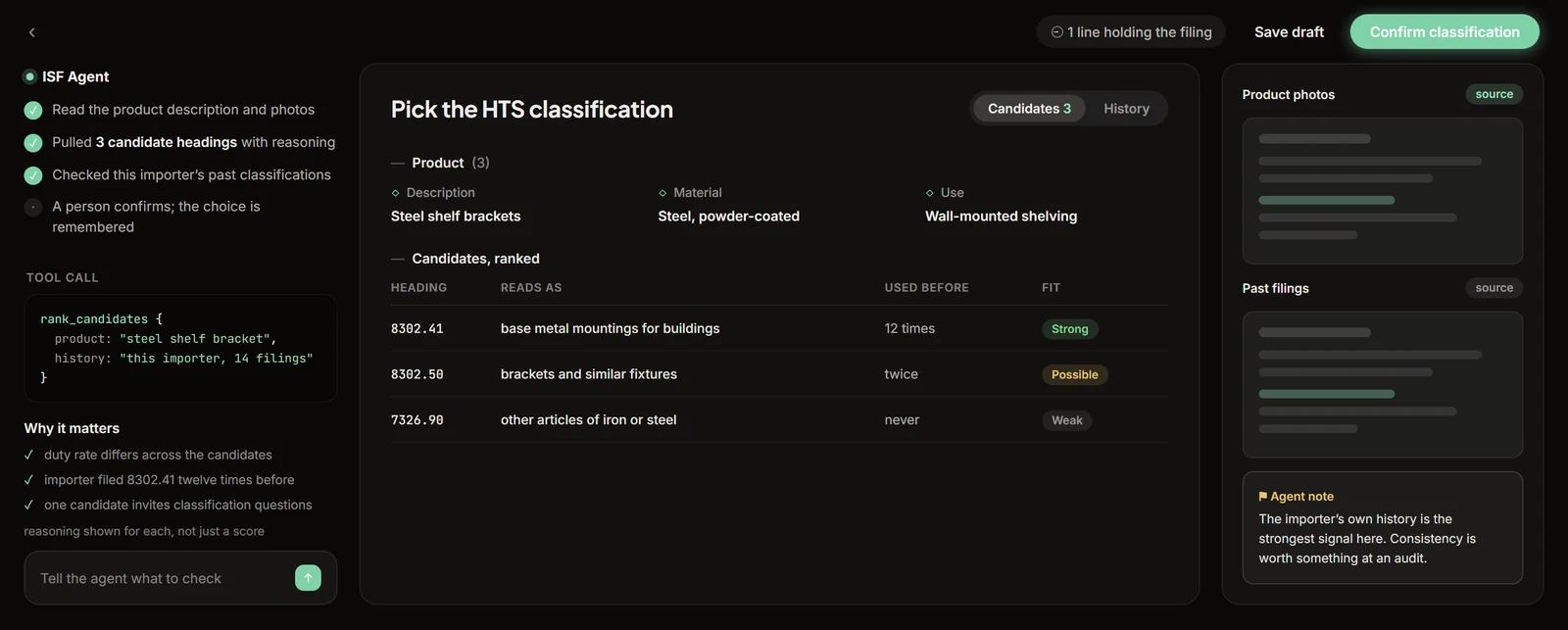
Nine fields are data. The tenth is a decision.
Walk the ten importer elements. Importer of record, consignee, seller, buyer, ship-to party, manufacturer or supplier, country of origin, container stuffing location, consolidator. Every one of those is a fact that appears somewhere on the documents in a stable form. A name, an address, a country, a facility. If you find the right document, the field is there to be copied.
The HTS-6 code is not like that. It is the answer to a question: what are these goods, for tariff purposes, at the six-digit heading level. The same shipment can be described as “cotton knit tops,” “ladies’ garments,” and “apparel” across three documents, and none of those phrases is the code. Someone has to decide which heading the goods fall under, and that decision depends on material, construction, use, and sometimes country of origin. A code that looks plausible for the description can still be the wrong heading. The format check is the trap. The portal confirms the code is a valid six-digit number, not that it is the correct one. A wrong code that is well formed files cleanly and sits there as a wrong entry in the customer’s name until someone notices.
Where the error enters
On most ISFs, the filer reads the HTS code off the commercial invoice or packing list that origin prepared, then keys it into the filing by hand. That single hop is where the error enters. Three failure modes show up again and again in real filings.
A transposed digit. The invoice reads 6109.10 and the filing goes in as 6019.10. Both are valid headings for entirely different goods. Nothing flags it because both pass the format check.
A code carried over from the wrong shipment. The same consignee’s last filing is open in another tab, its code gets reused, and the current shipment is a different product line. This is the quiet one, because the code is real and internally consistent. It is just not this shipment’s code.
A code that never got checked against history. The same importer has filed the same commodity dozens of times, under a settled heading, and this filing uses a different one for no reason anyone would defend if asked. Nobody looked, because looking meant opening prior filings one at a time.
None of these are knowledge failures. The person filing usually knows the tariff. They are data-handling failures, and they happen because the code is read off one document, typed into another, and never cross-checked against what the same importer filed for the same goods last time.
What assembling the data by hand actually looks like
The reason the check never happens is that assembling one ISF is already a multi-document job. The carrier elements are in the booking email. The party data and stuffing location are in the origin agent’s worksheet, almost always an Excel file. The commodity description sits on the commercial invoice, and the code, when origin supplied one, is on the invoice or packing list. The container and bill details are on the house bill.
A filer reads all of those, locates each field, keys it into the portal, and confirms the addresses. By the time they reach the HTS field, the twenty to thirty minutes of assembly is mostly spent, the deadline clock is running, and cross-referencing the code against the consignee’s filing history is one more manual step that, under time pressure, gets skipped. That skip is built into the process, not a lapse by the filer.
What changes when a machine assembles the data first
This is where automation earns its place, and where it has to be honest about its limits. The value is not that a machine can “file an ISF.” The value is that a machine can do the assembly and the cross-check in the time it takes to read this sentence, and then hand a person a complete draft with the risky field already flagged.
Our own ISF system runs that pass. It reads the origin worksheet and the house bill together in one go, extracts the ten-plus-two fields, resolves each party against known records, and writes a complete draft filing. On a typical shipment that read-and-pre-fill step finishes in under 30 seconds. Same work that takes a person twenty to thirty minutes, done before anyone opens the file.
The HTS field is handled differently from the other nine, on purpose. The system does not invent a classification and it does not overwrite the human’s judgment. It reads the commodity description off the documents, compares the code against the codes this same consignee has filed for this same commodity profile before, and when the current code deviates from that settled history, it flags the field. The transposed digit, the carried-over code, the heading nobody checked against history: those are exactly the deviations the cross-check surfaces. The system is not smarter about tariff law than your filer. It is more patient about checking the one thing your filer never has time to check.
How does prior-filing validation change the odds?
A forwarder’s own filing history is the most underused classification asset on the desk. The same importers ship the same commodities repeatedly, which means most classification questions have already been answered, correctly or not, in the operation’s own past ISFs. Checking a proposed HTS-6 against the codes previously filed for the same importer and commodity description does 2 useful things at once. It catches drift, the case where the same product has quietly been filed under 3 different codes by 3 different operators over the course of a year, which is a consistency problem CBP’s systems are built to notice before you do. And it surfaces precedent, the case where the current worksheet’s vague description matches a shipment that a careful operator classified properly 8 months ago, with the reasoning still visible in the email thread.
The validation is a lookup rather than a judgment, which is why it automates cleanly: flag when the proposed code disagrees with the importer’s filing history, show the history, and let the filer decide which is right. Sometimes the history is wrong and the new code is the correction; a history of 5 identical mistakes is still 5 mistakes. The point is that the disagreement becomes visible at filing time instead of at a CBP inquiry 2 years later.
The person still files
Nothing about this removes the human from the filing. The system produces a draft with every uncertain field marked, sends it to the operator, and stops. The operator reviews each flagged field, corrects what needs correcting, and submits by hand. The system saves the draft for review. It does not send anything to Customs. A responsible ISF workflow keeps it that way, because the filer of record carries the liability and the classification judgment is theirs to make. Automation moves the twenty-five minutes of data assembly off the operator’s plate and puts the two minutes of real judgment, mostly on the HTS field, right where it belongs.
That is the honest version of what AI does for ISF filing. It does not know your tariff better than you. It reads the four documents faster than you can open them, it never gets tired of checking the code against history, and it hands the hard decision to the person who is supposed to make it, with the risky field already circled.
If you file ISFs and want to see this run on one of your own shipments, worksheet, house bill, and all, book a short demo. Bring a filing that gave you trouble.
Frequently asked questions
Why is the HTS code the hardest field on an ISF filing?
The other nine importer fields on an ISF are identity and location data that appear on the documents in a fixed form: names, addresses, a country, a container stuffing location. The HTS-6 commodity code is different because it is a classification judgment, not a lookup. The same goods can be described three ways across the worksheet, the invoice, and the packing list, and the correct 6-digit heading depends on what the goods actually are, what they are made of, and sometimes their country of origin. A code that looks reasonable can still be wrong, and a wrong code that passes the portal's format check still files.
What happens if the HTS code on an ISF is wrong?
A wrong HTS code is a wrong compliance record filed in the importer's name, and the forwarder is the one who assembled it. Even when it does not surface right away, it can turn up later as a discrepancy against the entry that the importer then has to untangle. That is the kind of thing that makes a customer start double-checking your work. The importer relies on the forwarder to get the details right shipment after shipment, and the HTS code is the detail most likely to reveal whether that trust is earned.
Can AI classify HTS codes for an ISF filing?
AI should not replace a licensed classification judgment, and a responsible system does not try to. What it can do is read the commodity description off the documents, compare it against the codes the same consignee has filed for the same commodity profile before, and flag the current code when it deviates from that history. That surfaces the errors that actually happen in practice, such as a transposed digit or a code carried over from a different product line, and puts them in front of a person before submission rather than after.
Where does the HTS code on an ISF come from?
In most operations the HTS code is taken from the commercial invoice or the packing list prepared at origin, then keyed into the filing by hand. That is the moment the error enters: the code is read off one document, typed into another, and rarely checked against what the same importer filed for the same goods last time. The source data is scattered across the worksheet, the house bill, and the invoice, which is why assembling it correctly takes as long as it does.