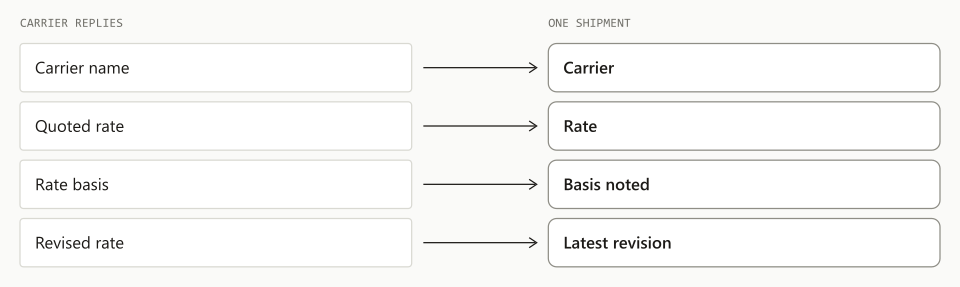
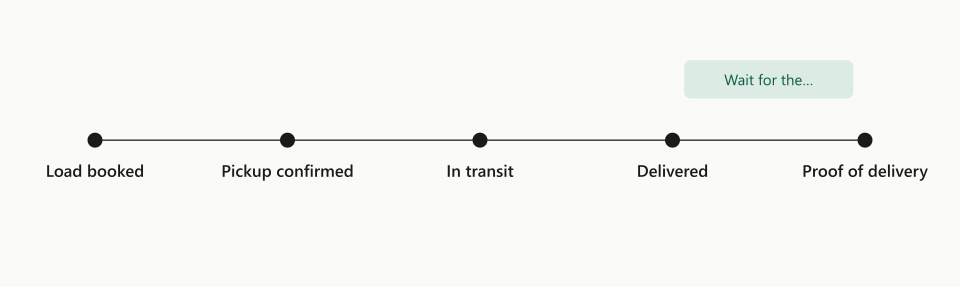
- Request arrives
- Shipment details read
- Rate or truck quote asked
- Price returned
- Reply in the thread
- Wait is on truckload: from rate or truck quote asked to price returned
An AI quote desk agent answers an LTL quote request in seconds: a median of about 12 seconds on a live trucking desk, against a 12-minute median on the manual desk it replaced. A customer emails “3 pallets, Thursday pickup” and has a priced reply in the same thread before they have switched windows. Truckload runs automatically too. The median FTL reply fell from 78 minutes to 26. The agent’s own work in that is about 2 minutes; the rest is the wait for the truck quote, which the agent requests, tracks and turns into a customer rate on its own. This post explains how both agents work, step by step, what happens after the customer says yes, and which requests still go to a person. The numbers come from a US trucking agency on the GlobalTranz network running TIO’s LTL and FTL agents.
- 12 secMedian LTL quote replywas 12 min
- 26 minMedian truckload ratewas 78 min
- 2 minAgent’s own work on a truckloadmedian
- 1 in 5Requests handed to a personby design
What is an LTL and FTL quote desk agent?
A quote desk agent is software that does the job of a freight quote desk: it reads the customer’s emailed request, prices the shipment, replies in the same thread, and books the load when the customer says yes. The customer changes nothing. They keep writing emails to the same address, in the same words, and a priced answer comes back in the thread.
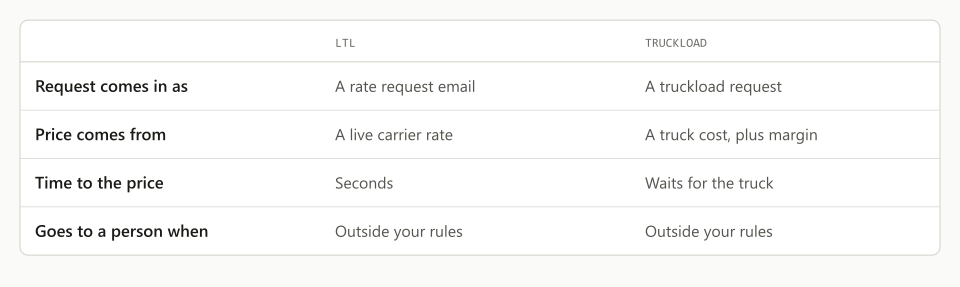
TIO runs two of them, one per mode, because the two jobs are different. LTL is priced through a live carrier rate call and finishes in seconds. Truckload has no instant rate, so the agent requests the truck quote and turns it into a customer price when it comes back. The design rules behind both are in how to automate LTL and FTL quoting.
How does the LTL quote agent work?
It runs six steps, and code makes every decision that carries money. The whole pass takes about 10 seconds.
- Read the email. The agent pulls pallets, dimensions, weight, the lane, the pickup day and any services the customer named, from the body and the attachments.
- Check what is missing. If a required fact is absent, it asks once, in one message, and matches the answer back to the same thread.
- Resolve the freight class. Code does this in a fixed order: the class the customer stated, then a class already confirmed for that customer’s commodity, then the density scale, then a question back. The freight class is the input most likely to be wrong on an LTL quote, so the model never picks it.
- Pull the rates. A live call returns prices from the carriers that serve the lane.
- Apply the agency’s rules. Margin, minimums, and a price ceiling come from settings the agency controls.
- Reply in the thread. A short list of options, the assumptions stated, and a plain way to accept.
On the manual desk, the first LTL quote went out a median 12 minutes after the request, which is a good human desk. The agent’s median is about 12 seconds. The gain on LTL is speed and consistency: the same class logic and the same pricing rule on every request, at any hour.
How does the truckload quote agent work?
It runs the whole loop for the customer, and most of the elapsed time is the wait for the truck quote. LTL has a live rate call that answers in seconds. Truckload does not. A truck has to be sourced and quoted for that lane and that day, and that takes minutes however the request is sent.
- 01Build the request108 secRead the email, fill lane, equipment, weight and dates, enter the quote
- 02Wait for the truck quote19 minThe truck is sourced and quoted; the agent checks every 5 minutes
- 03Price and reply5.7 secApply the margin rule, write the rate email in the customer’s thread
On the manual desk the same request sat in a mailbox until someone opened it, wrote back with questions, waited, and then asked for a cost. Nearly every truckload request needed a clarifying email before it was priced, and a quarter of customers waited more than 5 hours for a rate.
The agent removes the first and last waits. It enters a complete request without asking the customer anything it can read for itself, and the moment the cost lands it sends the rate. The median reply comes in at 26 minutes and three quarters arrive within 47. In the most recent week the median was 19 minutes. The fastest took about 13 minutes. Sourcing and quoting a truck sets that floor, not the agent. Nobody at the agency opens the request, chases the truck quote or types the rate email.
What happens after the customer says “book it”?
The agent books the load, dispatches it and sends the paperwork, and the team sees the result instead of typing it.
Before a booking is written, a second pass compares the order against what the customer actually asked for. Pieces, pallets and weight are checked by code. If the numbers disagree, the booking stops and a person looks.
For LTL, the bill of lading reaches the customer a median 10 minutes after the order is created. Truckload paperwork takes longer by design: a truckload bill of lading only goes out once a real carrier is assigned to the load. A bill with a placeholder carrier on it has to be reissued, and the customer ends up holding two.
After booking, the same roster keeps working the load. The pickup notice, the delivery update and the proof of delivery go to the customer in the right thread. That part is covered in automated freight tracking and POD.
What still goes to a person?
Roughly one request in five, and that is the system working as designed.
| Step | Manual desk | With the agents |
|---|---|---|
| Read the request | A person opens the mailbox | Read on arrival, fields filled |
| Missing facts | Several emails back and forth | One question, asked once |
| LTL price | Median 12 minutes | Median 12 seconds |
| Truckload rate | Median 78 minutes | Median 26 minutes |
| Booking paperwork | Typed and attached by hand | Sent by the agent after a code check |
| Odd freight, big prices, disputes | Handled in the same queue | Routed to a person with facts attached |
The hand-offs fall into a few groups. LTL shipments whose cost is above a ceiling the agency set are never priced automatically. A freight class the customer states that disagrees with the class table becomes a task. Hazmat, oversize and anything else the rules do not cover goes straight to the team. In each case the person starts from a read shipment and a set of rates, and makes one decision.
The agents act only where the agency has switched them on. Every write they can make, a quote reply or a booking, sits behind its own on and off switch per customer account, and every action leaves a record of who acted, when, and the before and after values. Your team sets the pricing rules and the ceiling, and can turn any one of those switches off in minutes.
What does this save a trucking agency?
It saves the reading, the typing and the waiting.
- Quote replies are written without a person, LTL and truckload alike.
- Booking paperwork goes out on its own: the bill of lading, the pickup notice and the proof of delivery.
- Orders are entered and dispatched by the agents, after a code check against the request.
- The clarifying emails mostly stop. The agent asks once, and only for a fact it cannot read.
Speed probably wins loads too. A customer who waits 5 hours for a truckload rate has usually emailed a second broker by then.
We are still watching whether the LTL quotes hold. If a carrier reweighs or reclassifies a shipment, the customer gets a second bill weeks later and the fast quote did them no favor. Those adjustments take a month or more to show up.
How do you measure your own quote desk?
Measure five things from your own mailbox before you change anything. You need the baseline to know whether automation helped.
- Time to first quote. Subtract the request timestamp from the first priced reply. Take the median, not the average, and note the slowest quarter.
- Questions back. Count how many requests needed a clarifying email before a price. This is the number that hides the most labor.
- Re-quotes. Count how often the same shipment was priced twice.
- Booking messages. Count the emails between “please book” and the bill of lading.
- Hand-offs. Once agents run, count what goes to a person and group it by reason.
Split everything by mode. Our own baseline would have looked fine as one blended number, and it hid a truckload desk where a quarter of customers waited more than 5 hours.
Where this fits
TIO is an AI agent workforce for freight forwarders and 3PLs, and the quote desk agents are the part of it built for trucking agencies and freight brokers. They sit on top of the TMS the agency already runs, read the inbox the team already uses, and leave the system of record alone. The full list of services is on the AI automation for trucking agencies page.
If your desk prices LTL and truckload out of a shared mailbox, book a 20-minute demo. We run it on one of your real requests, so you see the read, the price, the checks and the hand-off queue on your own freight.
Frequently asked questions
How fast can an AI agent reply to an LTL quote request?
On a live trucking desk the median LTL quote reply leaves about 12 seconds after the customer's email arrives, against about 12 minutes on the manual desk it replaced. The work itself takes about 10 seconds. The slow replies are the ones where a required fact is missing and the agent has to ask the customer one question first.
Can an AI agent quote full truckload freight on its own?
Yes, from the customer's side. The agent reads the request, asks for the truck quote, waits for it, prices the load and replies, with nobody at the agency touching it. The median truckload reply takes about 26 minutes, against about 78 minutes by hand. Most of the 26 minutes is the wait for the truck quote. The agent's own work is about 2 minutes on a typical request and averages under 6 minutes across a week.
How many quote requests still need a person after automation?
Roughly 1 in 5 on the desk we measured. The usual reasons are freight above the automatic price ceiling, a freight class dispute, or a request the rules do not cover, such as hazmat. Each one reaches the person with the shipment already read and the rates attached.
What does a quote desk agent do after the customer says book it?
It creates the order, checks pieces, pallets and weight against the request, dispatches, and emails the bill of lading. On LTL the bill of lading reaches the customer a median 10 minutes after the order is created. The same roster then sends the pickup notice and the proof of delivery without anyone typing them.