- 01Base dutyfrom the product tariff code
- 02Origin-based layerset by country of origin
- 03Product-based layerset by what the goods are
- 04Trade-remedy layeronly when an order applies
- 05Total duty on the linedepends on which layers stack
Tariff stacking is when two or more US import duties apply to the same entry line at once, so the importer pays a base rate plus one or more extra layers. In 2026 most extra layers come from Section 232 and Section 301, and each is its own heading in Chapter 99 of the tariff schedule. Most layers add to the base rate: the schedule’s wording for a steel, aluminum or copper article is the base duty plus 50%. Some do not add. A few Section 232 headings set one combined rate, such as 15% in total, and some programs switch another program off. On October 9, 2026, U.S. Customs and Border Protection (CBP) listed 13 such programs, and the tariff schedule was on its 21st revision of the year. Date every answer and check it against a 2026 government text. Your licensed customs broker decides what is filed.
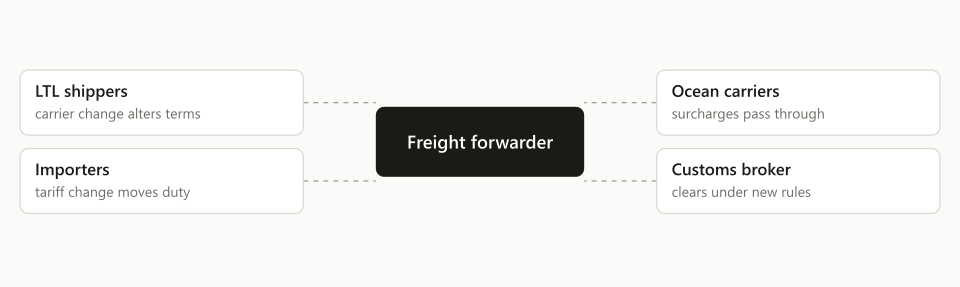
Importers ask their forwarder first. “What will the duty be?” reaches the operations inbox before the purchase order goes out, and the answer has more than one part. If you answer that email, this is a working method. It is not customs advice, and it offers no code for any product.
What is tariff stacking?
Tariff stacking is the charging of more than one duty on a single imported line. CBP uses the word the same way. Its chart on the subject exists to show which orders and proclamations may stack, which it defines as:
“apply concurrently to the same product” (U.S. Customs and Border Protection, Unstacking Certain Tariffs Chart, last modified January 28, 2026)
You need four terms.
- Base rate. The duty on the product’s own line in Chapters 1 to 97 of the schedule, found by its HTS code. Proclamations call it the column 1 rate.
- Layer. Any extra duty on top of the base rate. Each layer comes from a separate legal action.
- Chapter 99 heading. An 8-digit number, such as 9903.88.01, that carries a layer on the customs entry. CBP’s metals guidance alone lists 16 of them, 9903.82.02 through 9903.82.17.
- Unstacking. A rule that stops two layers from applying to the same product.
The number of layers is why the question got hard. CBP’s Trade Remedies page listed 13 programs on October 9, 2026: 8 under Section 232, 4 under Section 301 and 1 under Section 338. Antidumping and countervailing duty (AD/CVD) is tracked apart from those 13.
What does a tariff stacking chart look like?
A tariff stacking chart puts every layer on one line and says where each is written and how it meets the base rate. The last column is where totals go wrong.
| Layer | Where it is written | How it meets the base rate |
|---|---|---|
| Base duty | The product’s own line, Chapters 1 to 97 | It is the starting point |
| Section 301 | Chapter 99, such as heading 9903.88.01 | Adds. The heading reads “the duty provided in the applicable subheading plus 25%“ |
| Section 232, standard heading | Chapter 99, such as heading 9903.82.02 | Adds. The heading reads base ”+ 50%”, on the full customs value |
| Section 232, combined-rate heading | Chapter 99, such as headings 9903.82.10 and 9903.04.60 | Does not add. Base and Section 232 together equal the stated rate: 15%, or 100% on patented pharmaceuticals |
| AD/CVD | Tracked by CBP apart from the 13 programs | Continues on top of everything above, when an order covers the goods |
We use a four-question check on every layer before a rate goes to a customer:
- Does this layer name this code from this country?
- Does another layer switch it off?
- Does it add to the base rate, or set a combined rate?
- Which date’s rule applies to this entry?
In what order do you work through a tariff stack?
Work outward from the product’s own line, and settle each program to one rate before you total anything. Eight steps cover it.
- Start from a code and origin someone has named. The broker or a filed entry supplies the 10-digit code. Do not guess one.
- Read the base rate. It sits on the product’s own line.
- List every program that names the code. The metals and pharmaceutical messages each attach the list of product codes that fall under each Chapter 99 heading.
- Settle each program to one rate. When two rates in the same proclamation fit, the lowest applies. An article listed under steel, aluminum and copper pays the metals duty once.
- Check the exclusions between programs. You read CBP’s chart from the top: go down the product column and stop at the first row that describes the goods. Its first 3 rows are semiconductors, then autos and auto parts, then medium and heavy trucks.
- Check how each layer meets the base rate. Add it, or use the combined rate.
- Put AD/CVD beside the total. Take it from the filed entry. A published flag only says the code is on a list.
- Date it. Each rule starts for goods entered on or after a stated minute, such as 12:01 a.m. on April 6, 2026 for the metals change.
A caution on step 5: the spreadsheet on CBP’s chart page is dated January 27, 2026. That is before the April metals proclamation. The chart also still carries columns for duties under the International Emergency Economic Powers Act (IEEPA), which Executive Order 14389 ended on February 20, 2026. Use the method. Confirm each cell against the newer messages.
Which tariff layers apply together, and which exclude each other?
Most layers apply together, and every exclusion is written into a specific text. These are the 7 rules we could confirm in 2026 government sources, as read on October 9, 2026.
| Situation | What the 2026 text says |
|---|---|
| Section 232 metals and AD/CVD on one line | Both apply. Antidumping, countervailing and other duties continue to be imposed. CBP message #68253075, April 3, 2026 |
| Steel, aluminum and copper in one article | The metals duty is charged once, however many of the 3 metals the article is listed under. Proclamation 11021, clause 9 |
| Two rates fit inside one program | The lowest applicable rate applies. Proclamation 11032, clause 3(b) |
| A listed article with little metal in it | 0% when the metal is under 15% of the weight, outside Chapters 72, 73, 74 and 76. CBP message #68253075 |
| Section 232 and a free trade preference | On pharmaceuticals, the Section 232 duty is collected in addition to the special rate. CBP message #70054007, September 28, 2026 |
| Section 301 on a product of China | Where heading 9903.88.01 covers the goods, the base rate plus 25%. US tariff schedule, revision 21 |
| Semiconductors and the vehicle or metals duties | Goods filed under the semiconductor heading are not also charged the vehicle, copper, aluminum or steel duties. CBP message #67400472, January 14, 2026 |
Read the last row with its date. That message names the metals headings in use in January. The April guidance moved the metals duty to new headings, so ask the broker whether the exclusion carries over.
We left out every rule we could not find in a 2026 government text. That includes how the vehicle, timber and Canada programs meet each other. A missing row is a question for the broker. It does not mean the duty is zero.
Do stacked tariffs add up or compound?
Most stacked tariffs add up, and a few do neither. Each additive layer is a percentage of the same customs value. In the headings quoted here, no layer is charged on another layer’s duty. Proclamation 11021 says the metals duty applies to the full customs value of the product from April 6, 2026, whatever its metal content.
The exception is the combined-rate heading. Here the schedule sets the base rate and the Section 232 duty together, as one number.
| Heading type | What the schedule says | A line with a 2.5% base rate pays |
|---|---|---|
| Additive, 9903.82.02 | ”The duty provided in the applicable subheading + 50%“ | 52.5% |
| Combined, 9903.82.10 | 15%, where the base rate is under 15% | 15% in total, of which Section 232 is 12.5% |
| Combined, 9903.82.11 | No additional duty, where the base rate is 15% or more | The base rate only |
The common error on a combined heading is to add 15 to 2.5 and quote 17.5%. The text says the sum is 15%. The patented pharmaceutical heading works the same way at a higher number: CBP describes its 100% as the combined column 1 and Section 232 rate.
How do you calculate the total duty on a stacked line?
Multiply the entered value by each additive rate on its own, then sum the results. The example below is made up. The value, the rates and the product are invented, and none of it is a tariff rate for real goods.
Take one line with an entered value of $40,000, a 10% base rate, a 25% Section 301 layer and a 50% Section 232 layer under an additive heading. The pairing is a real one: CBP’s Section 232 questions page, modified September 21, 2026, says a line in Chapters 72, 73 or 76 may be subject to Section 232 and/or Section 301 duties.
| Layer | Rate | Duty on $40,000 |
|---|---|---|
| Base duty | 10% | $4,000 |
| Section 301 | 25% | $10,000 |
| Section 232 | 50% | $20,000 |
| Total | 85% | $34,000 |
A quote built on the compounded figure is $8,500 too high on one line, and your customer sets a selling price on it.
Now change one thing. Put the Section 232 layer under a combined 15% heading, with a 2.5% base rate and no Section 301. The total is 15% of $40,000, which is $6,000. Adding the two rates gives 17.5% and $7,000, an overstatement of $1,000.
Where does CBP publish tariff stacking guidance?
CBP publishes it in 3 places, and it says itself that none of them is the final word. Two more sources sit behind those.
| Source | What it gives you | Dated |
|---|---|---|
| CBP messages (Cargo Systems Messaging Service) | The Chapter 99 headings, rates and start time for one action | #70054007, September 28, 2026 |
| CBP Trade Remedies page | An index of 13 programs, each with its message numbers and Federal Register cites | Modified October 1, 2026 |
| CBP Unstacking Certain Tariffs Chart | Which programs may apply to one product at once | Spreadsheet dated January 27, 2026 |
| Federal Register | The proclamation text itself | 91 FR 34085, June 4, 2026 |
| US tariff schedule, Chapter 99 | Each heading and the wording of its rate | Revision 21, in effect October 9, 2026 |
CBP labels its chart a courtesy. The same note says the proclamations, executive orders and Federal Register notices decide how a tariff applies, and that the importer is responsible for reasonable care in working out the amount.
If you have seen “the tariff stacking executive order” mentioned, that is Executive Order 14289. CBP’s questions page on IEEPA duties calls it the “unstacking” order, and that page is now kept for reference only. The 2026 metals, pharmaceutical and semiconductor texts each carry their own stacking clauses, which is why the table above cites them one by one.
What changed in tariff stacking rules during 2026?
Enough that a chart saved in January is out of date in at least 2 places by October.
- January 15. A 25% Section 232 duty on certain semiconductors took effect, with its own list of duties it excludes.
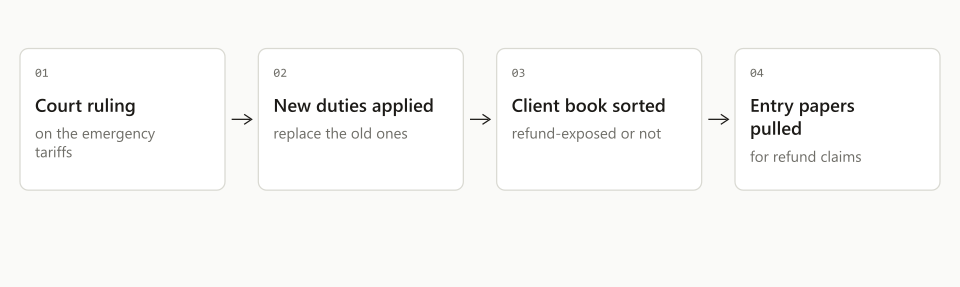
- February 20. Executive Order 14389 ended the additional duties imposed under IEEPA. The court ruling behind it is covered in what forwarders must know about the IEEPA tariffs.
- April 6. The metals duty moved to the full customs value, at 50%, 25%, a combined 15% or 10%, and an article of 2 or 3 metals began paying it once.
- June 8. Farm equipment and some home heating and cooling equipment moved into the combined 15% tier, and the bar for metal counted as American dropped from 95% to 85% of weight.
- July 31 and September 29. The patented pharmaceutical duty started, first for named companies and then for all others.
- September 3. Section 232 duties of 10% to 100% began on unmanned aircraft and their parts.
- October 7. A Federal Register notice confirmed that the Section 301 actions on China remain in effect.
- October 9. Revision 21 of the tariff schedule took effect, the 6th revision since August 14.
Six schedule revisions in 8 weeks is about one every 11 days, so a rate you confirmed last month needs a second look before you quote it again.
How does a forwarder keep stacked rates current?
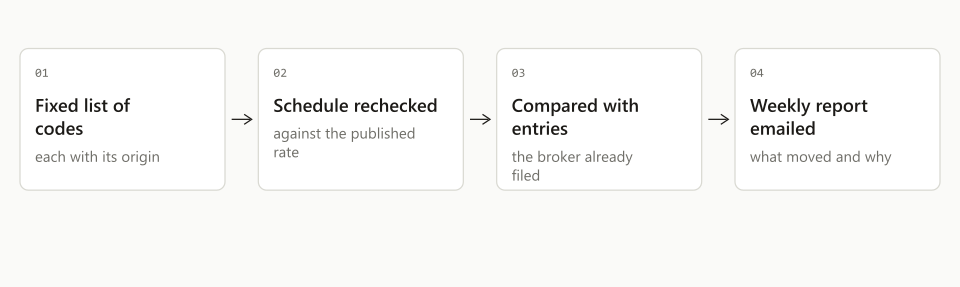
Recheck the same list on a fixed day every week, and keep each layer in its own column. A total with no parts cannot be checked, and it cannot be compared with last week.
That is the job TIO’s customs and duty agent does. On its first live weekly run for a US import freight forwarder, it rechecked 30 code and origin pairs in under 7 minutes. It confirmed 29 against the government schedule and sent 1 to a person, because two sources disagreed. Any single duty line at or above 50% is read three times, and the email says in plain words what that line is. The AD/CVD column comes from the entries the broker has filed, not from a published flag. The full method is in the weekly HTS code and duty rate audit.
You can run the same check by hand. List your top 20 code and origin pairs, give each layer its own column, mark each one “adds” or “combined”, and recheck every week.
Where does this fit in a forwarder’s back office?
TIO is an AI agent workforce for freight forwarders and 3PLs, and the customs and duty agent works next to the agents that quote, enter orders and match payables. It reads the mailbox your team already uses and works alongside the TMS you already run. The roster is on the agents page, and the forwarder setup is on AI agents for freight forwarders.
The agent does not classify goods and files nothing. Its email goes to your operations team, and a person decides what reaches the customer. Which layers are declared on an entry is the licensed customs broker’s decision.
If your team answers duty questions from memory and old quotes, book a 20-minute demo. Bring 5 codes your customers import, and we will run the stack on them while you look.
Frequently asked questions
What is tariff stacking?
Tariff stacking is when two or more US import duties apply to the same entry line, so the importer pays a base rate plus extra layers such as Section 301 and Section 232. U.S. Customs and Border Protection listed 13 such programs on October 9, 2026. Most layers add to the base rate, and a few set one combined rate instead.
Do stacked tariffs add up or compound?
Most add up. The US tariff schedule writes a standard Section 232 metals heading as the base duty plus 50%, charged on the same customs value as the base rate, so a 10% base with 25% and 50% layers totals 85%, not 106.25%. Some headings do not add at all: heading 9903.82.10 sets the base rate and Section 232 together at 15%.
What is the order for working out stacked tariffs?
Start with the base rate on the product's own line, list every Chapter 99 program that names the code, settle each program to 1 rate, check the exclusions between programs, then add or combine. CBP's Unstacking Certain Tariffs Chart, dated January 27, 2026, is read from the top row down and stops at the first row that describes the goods.
Does Section 232 stack with antidumping and countervailing duty?
Yes. CBP message #68253075 of April 3, 2026 says antidumping, countervailing and other duties continue to be imposed on goods that fall under the Section 232 duty on steel, aluminum and copper. The same message says an article listed under 2 or 3 of those metals pays the metals duty once.
Where does CBP publish tariff stacking guidance?
In 3 places: Cargo Systems Messaging Service messages for each action, the Trade Remedies page that indexes 13 programs with their message numbers, and the Unstacking Certain Tariffs Chart. CBP states that the chart is a courtesy and that the proclamations and Federal Register notices decide how tariffs apply.
Does an AI agent decide which tariffs stack on a product?
No. TIO's customs and duty agent looks up and rechecks the layers for codes a person or a filed entry has already named, and its first live weekly run checked 30 code and origin pairs in under 7 minutes. Classification, and which layers are declared on the entry, stay with the licensed customs broker. The agent files nothing with CBP.